
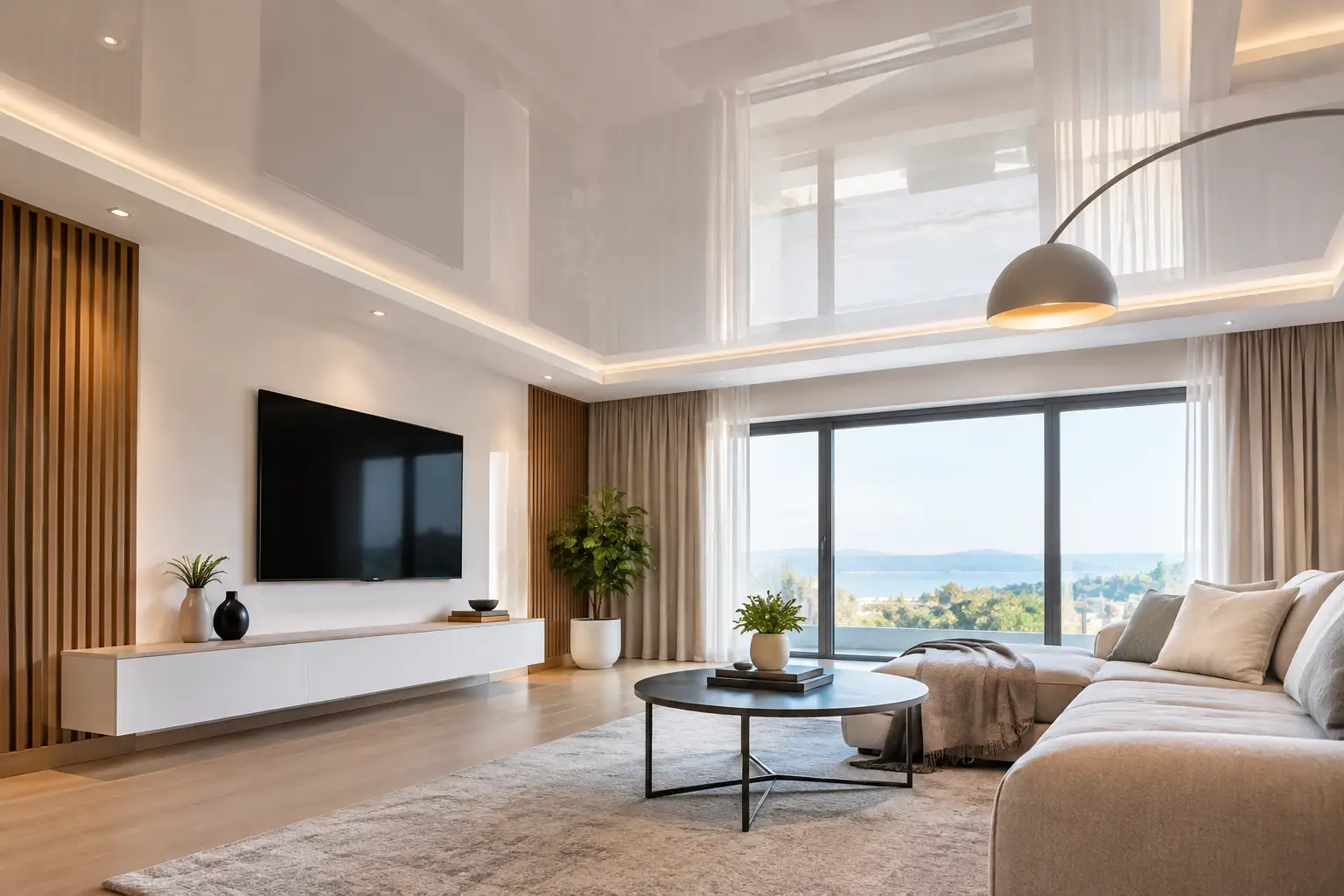
Vecta Stretch Ceilings for Refined Interior Performance
A ceiling often carries more visual and technical responsibility than any other plane in a room. It must accommodate lighting, ventilation, sprinklers, sensors, access points, acoustics, and structural irregularities while preserving the clarity of the interior concept. Vecta Stretch ceilings provide a disciplined way to combine these requirements in one finished architectural surface.
For hospitality, retail, workplace, marine, and high-end residential projects, the value lies not simply in a smooth overhead finish. A stretch ceiling can help control reflection, light distribution, sound, service integration, and perceived room proportions while maintaining precise architectural detailing.
What Vecta Stretch Ceilings Make Possible
Vecta Stretch ceiling is a tensioned membrane installed within a perimeter or structural profile system. Once tensioned, it forms a clean, continuous plane beneath the existing soffit or ceiling construction. The void above remains available for technical services, insulation, acoustic layers, lighting equipment, and maintenance access.
The system is particularly useful where existing structures are uneven, crowded with services, or not intended to remain exposed. Instead of requiring multiple trades to create a visually perfect soffit, the stretch surface establishes a finished plane below it. It can also be configured around curves, slopes, cutouts, and integrated details.
A Ceiling System, Not Just a Surface
The strongest projects treat the membrane, profiles, lighting, acoustics, and access strategy as one coordinated system. A visually uninterrupted ceiling is convincing only when the supporting components are considered from the first drawing set.
Integrated lighting with defined visual control
Light lines, backlit fields, recessed details, magnetic tracks, and perimeter illumination can be incorporated into the ceiling composition. The membrane can act as a diffuser for broad, even luminous surfaces, helping designers avoid visible pixelation or uneven brightness associated with poorly specified backlighting.
For backlit ceilings, the depth of the light box, membrane properties, LED spacing, output, color temperature, driver access, and thermal management all influence the final result. A luminous ceiling should therefore be tested as a complete assembly rather than selected from a material sample alone. The goal is consistent illumination across the full field, including edges, corners, and transitions around penetrations.
Acoustic comfort without visual clutter
Large, hard-surfaced interiors can look refined yet perform poorly for conversation, concentration, and hospitality. Vecta Stretch ceilings can support acoustic strategies by combining perforated or acoustically transparent membranes with absorptive material in the plenum. This allows the ceiling to contribute to sound control while retaining a clean visual plane.
Where stronger absorption is needed, the approach should be modeled and specified against measurable performance requirements rather than assumed from appearance.
Concealed infrastructure with planned access
Sprinklers, speakers, detectors, cameras, air valves, inspection hatches, and cabling still require coordinated locations, reinforcement, and a maintenance plan. Vecta Stretch systems allow many services to be discreetly integrated, but access should be resolved before installation. Depending on maintenance frequency and equipment above the ceiling, components may be reached through locally released membrane sections, purpose-designed access panels, or removable elements.
Where Vecta Stretch Ceilings Deliver the Most Value
Vecta Stretch ceilings are effective where finish quality must remain high despite complex coordination. In hotel reception areas and restaurants, they can unify lighting and acoustic treatment into a calm ceiling field. In retail, they support branded geometries, luminous surfaces, and concealed infrastructure without compromising the customer environment.
For marine interiors, weight, movement, compact service zones, durability, and demanding finish expectations make engineered ceiling systems especially relevant. In luxury residences, the opportunity is often subtler: perfectly flat ceilings, shadow-free lighting integration, climate distribution, and acoustically calmer living spaces.
Key Specification Decisions
Material choice should follow the desired architectural effect and performance requirements. Matte finishes suit quiet, non-reflective surfaces; satin adds restrained light play; gloss and Vecta mirror finishes create drama and visual expansion but demand greater discipline in lighting placement and surrounding detailing. Printed surfaces, translucent membranes, and custom colors provide additional flexibility when the ceiling is intended to carry visual identity.
A premium result also depends on accurate interfaces between the ceiling and walls, joinery, glazing, and other systems. Profiles establish perimeter edges and define joints, recesses, curves, levels, and transitions. Their geometry should be coordinated early rather than treated as a hidden component after the design is complete.
Specification teams should establish fire classification, acoustic requirements, lighting performance, humidity exposure, cleaning expectations, access needs, and local code obligations early. Requirements vary by jurisdiction and application, so a ceiling designed for a private residence is not automatically suitable for a public assembly area, commercial kitchen, healthcare environment, or vessel.
Detail Early, Install with Discipline
Every penetration should be confirmed before fabrication, including downlights, diffusers, detectors, speakers, sprinklers, curtain tracks, ceiling-mounted furniture, and future access locations. Late changes may affect membrane layout, reinforcements, installation sequence, and visual consistency.
Lighting mockups deserve particular attention. Rendered luminous ceilings cannot fully reveal real diffusion, reflections, glare, or edge brightness. Testing a representative section helps confirm output, material selection, and profile geometry before a large installation is committed.
Designing for Long-Term Appearance
A well-specified Vecta Stretch ceiling should remain clear, stable, and serviceable over time. Cleaning methods should match the membrane finish, especially for high-gloss or printed surfaces. Facility teams should receive clear information on permitted cleaning products, access procedures, and the location of concealed technical components.
When a ceiling must carry both visual ambition and technical complexity, Vecta Stretch ceilings offer a precise architectural response. Start with the desired plane, then coordinate every light source, acoustic layer, service point, and edge around it. Early discipline is what allows the final ceiling to look calm, intentional, and complete.